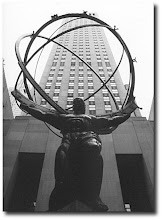
(DO NOT READ IF YOU PLAN TO READ ATLAS SHRUGGED.)
For the record, I started Atlas Shrugged back in November, before the internet was filled with studies documenting the positive correlation between sales of the book and the state of the economy. I started the recent bandwagon, I did not hop on it.
I had returned from a beach vacation and decided that I needed to read something other than Vince Flynn and John Grisham. I don't mind reading trash from time-to-time, but I needed to read something substantial. Somehow I settled on Atlas Shrugged, not really knowing what to expect.
The story is about how seemingly innocent changes to an economy, made with the best intentions, will inevitably lead to its downfall. The only thing that survives are the principles and values held close by a few industrialists, entrepreneurs and thinkers. In theory, economies should perform better when left to their own devices. The state of the economy in the book begins crumbling the moment the Unification Board starts interfering. In an attempt to increase equality, the Board distorts incentives to such a degree that the country grinds to a halt.
Overall I really enjoyed the book. I was surprised to find that I already viewed the world in a similar fashion to Rand: I'm big on self-sufficiency, staying true to one's beliefs and the ideals of laissez-faire.
My timing could not have been better. As the powers that be in the book slowly started regulating everything, talk of 'bad banks' and Government Motors (GM) became more and more prevalent. The parallels were uncanny. So far, the real has yet to spiral to the depths that the fictional US does, but we may be on our way.
The book is huge, literally and figuratively. She fully succeeds in getting her point across. It's powerful. It resonates.
Wikipedia has a good entry here, a discussion of themes and symbols is here and a recent piece comparing the book to the world we are currently in is here.
31.3.09

29.3.09
Nursery Rhyme Bailout
Old Obama has several banks
Trilli-illy-o
And in these banks there were bad assets
Trilli-illy-o
With some MtM here
And a writedown there
Here a loss, there a loss
Everywhere a loss-loss
Old Obama has several banks
Trilli-illy-o
Old Obama has a few mortgages
Ree-ee-ee-ee-set
And now these mortgages are not affordable
For or or close
With a for-sale sign here
And a for-sale sign there
Here a sign, there a sign
Everywhere a sign-sign
Old Obama has few mortgages
Ree-ee-ee-ee-set
Old Obama has a FED
Print some more money
And with this money go to the mall
Speh-eh-eh-end
With some more debt here
And some job losses there
Here some debt, there some losses
Everywhere some debt-loss
Old Obama has a FED
I-i-i-i-flation
Trilli-illy-o
And in these banks there were bad assets
Trilli-illy-o
With some MtM here
And a writedown there
Here a loss, there a loss
Everywhere a loss-loss
Old Obama has several banks
Trilli-illy-o
Old Obama has a few mortgages
Ree-ee-ee-ee-set
And now these mortgages are not affordable
For or or close
With a for-sale sign here
And a for-sale sign there
Here a sign, there a sign
Everywhere a sign-sign
Old Obama has few mortgages
Ree-ee-ee-ee-set
Old Obama has a FED
Print some more money
And with this money go to the mall
Speh-eh-eh-end
With some more debt here
And some job losses there
Here some debt, there some losses
Everywhere some debt-loss
Old Obama has a FED
I-i-i-i-flation
I'm A Fan Of This Tax Increase
I'm not a big fan of taxes. I'd rather pay less than more. But this tax I like. I bear the brunt of smokers indirectly. I have to smell it and breath in smoke. And I have to pay their hospital bills through my taxes. Therefore, increasing the cost of this habit can not be a bad thing.
Hopefully, the extra revenue generated from an increased tobacco tax will remove the burden of their healthcare costs from me. I wonder how many people would smoke if they had to pay for their own care when they get lung cancer?
On the other hand, maybe I'm contradicting myself. People should be able to slowly kill themselves if they so choose. Who am I to say whether or not that's a good idea? But the other part of me just thinks: "tax the living daylights out of tobacco". And I think that's the part of that will win out.
Hopefully, the extra revenue generated from an increased tobacco tax will remove the burden of their healthcare costs from me. I wonder how many people would smoke if they had to pay for their own care when they get lung cancer?
On the other hand, maybe I'm contradicting myself. People should be able to slowly kill themselves if they so choose. Who am I to say whether or not that's a good idea? But the other part of me just thinks: "tax the living daylights out of tobacco". And I think that's the part of that will win out.
28.3.09
Good Piece From Rolling Stone
This stuck out:
He maintains a good balance between scathing sarcasm and simplifying complex events. A lot of time is spent mapping out the relationships of the current players: Paulson, Geithner and the guys who were/are running banks. It's a small world and everyone wants to help out their old friends.
The entire piece by Matt Taibbi can be found here.
As complex as all the finances are, the politics aren't hard to follow. By creating an urgent crisis that can only be solved by those fluent in a language too complex for ordinary people to understand, the Wall Street crowd has turned the vast majority of Americans into non-participants in their own political future. There is a reason it used to be a crime in the Confederate states to teach a slave to read: Literacy is power. In the age of the CDS and CDO, most of us are financial illiterates. By making an already too-complex economy even more complex, Wall Street has used the crisis to effect a historic, revolutionary change in our political system — transforming a democracy into a two-tiered state, one with plugged-in financial bureaucrats above and clueless customers below.
He maintains a good balance between scathing sarcasm and simplifying complex events. A lot of time is spent mapping out the relationships of the current players: Paulson, Geithner and the guys who were/are running banks. It's a small world and everyone wants to help out their old friends.
The entire piece by Matt Taibbi can be found here.
27.3.09
FIrst Pass
Mini-Madoff, Canadian style [Bloomberg]
Ecuadorean oil cuts [IHT]
Surprise build in US nat gas stocks, sends price back down [Forbes]
Taleb's crusade rages on [Slate]
A scathing story about working at AIG [Clusterstock]
Ecuadorean oil cuts [IHT]
Surprise build in US nat gas stocks, sends price back down [Forbes]
Taleb's crusade rages on [Slate]
A scathing story about working at AIG [Clusterstock]
26.3.09
25.3.09
All of AIG Exposed
Apparently, the insurance side was into crazy derivatives as well. The whole company was making massive bets. This story just keeps getting better and better. I wonder what will happen next? One side of the company was selling complex, structured products to the other?
Subscribe to:
Posts (Atom)